The 21st Century Cures Act and ONC's December 2023 EHI export mandate gave every patient a legal right to their complete health record. Many providers now offer single-patient EHI exports. The data transport problem is largely solved, and FHIR is its centerpiece.
But access is not the same as usability. What arrives at the patient is a raw FHIR bundle, a sprawling C-CDA XML archive, or an unstructured PDF. These formats were engineered for institution-to-institution exchange, not for a patient managing a chronic condition across five providers. FHIR is an exceptional shipping container, but it does not deliver usable, readable, or actionable information to patients. Cascade Bridge was designed to close that gap.
Collect. Connect. Control.
Patients face three distinct barriers, and the Cascade Bridge design is organized around closing each one.
Collect
EHI exports from FHIR or C-CDA systems, PDFs and scans, wearable streams, and self-reported data go into one patient-owned pod.
Connect
Every record becomes RDF anchored to standard codes. A reconcile step deduplicates records and keeps conflicts with their sources.
Control
Explore your record by meaning, correct it without erasing the source, ask AI questions with citations, and share selectively through a health wallet.
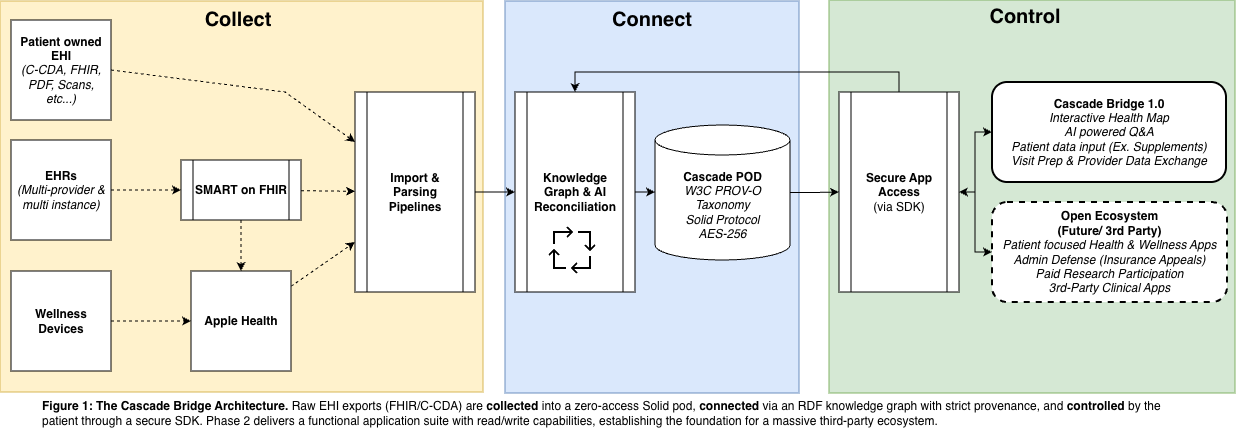
An earlier framing of these three C's used "Communicate" as the third pillar. Working through the EHIgnite submission sharpened our thinking: communication is just one thing a patient does with a unified record. The deeper promise is control: correcting records while preserving source authority, reasoning over them with AI, responding to living updates like a genomic reclassification, and sharing selectively on the patient's own terms. Control is the superset, and it is the right third pillar.
Why we designed it as an EHIgnite submission
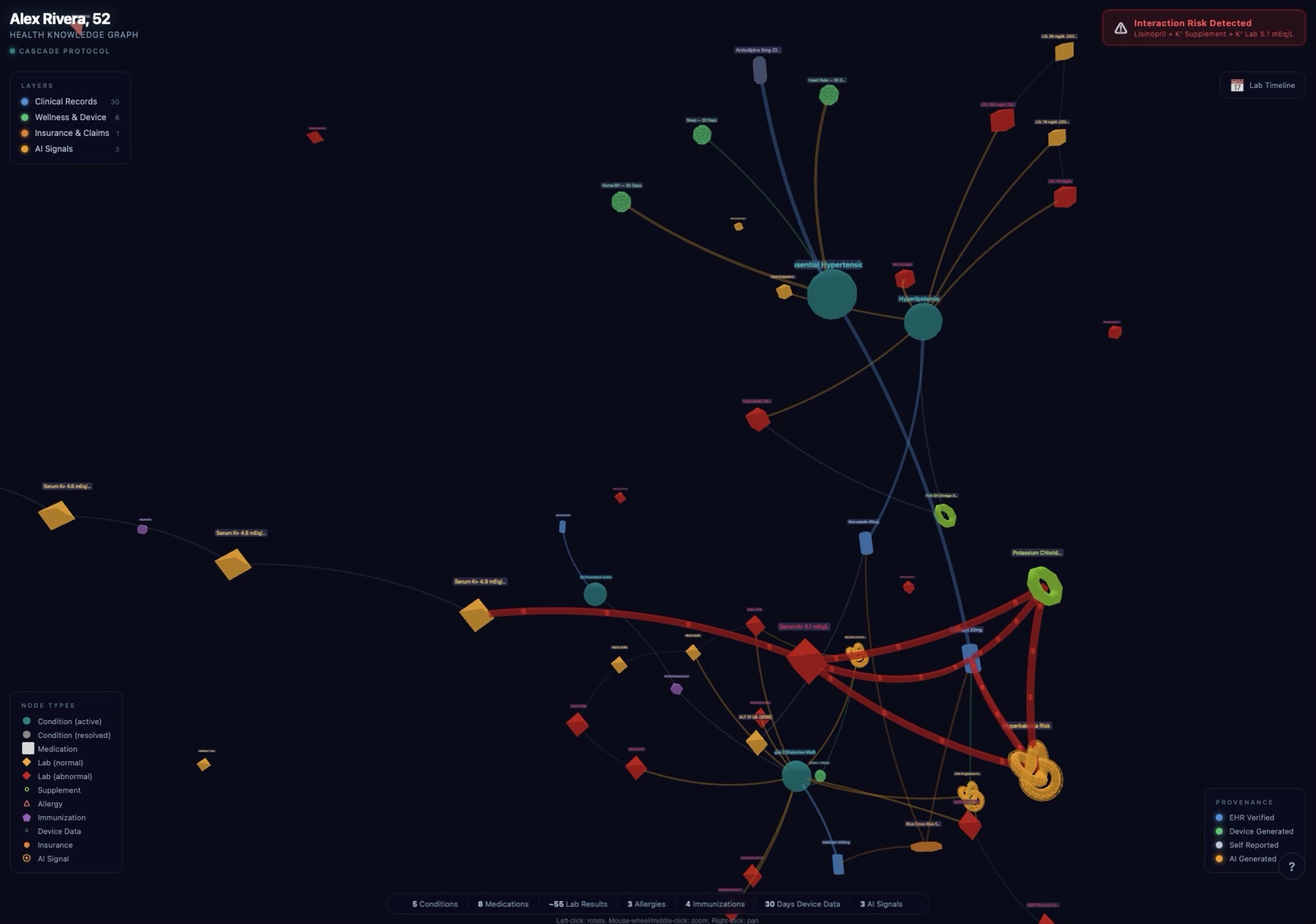
The ONC EHIgnite Challenge asks a pointed question: now that single-patient EHI export is a legal right, how do we turn those exports into something usable, readable, and actionable? That is exactly the gap the Cascade Protocol was designed to close, so Cascade Bridge became our answer. The submission made us be concrete about the whole journey, from an import pipeline that takes many formats, through RDF reconciliation that keeps conflicting sources instead of overwriting them, to patient-facing experiences that static files cannot offer: AI Q&A with a citation for each claim, a BRCA2 variant result that updates when a consortium reclassifies it, and a wallet-mediated SMART Health Check-in instead of a paper clipboard. These were designed, not built.
The thread that ties it together is the same one that runs through everything we build: provenance recorded on each record and checked by validation, so that an AI agent does not have to guess whether a heart-rate reading came from a Fitbit or an ICU monitor.
What exists today
The Bridge app is not built. Parts of the protocol under it are. POTS Check is live on the App Store and runs an early private copy of the Cascade Swift SDK. The cascade CLI converts FHIR and C-CDA and can reconcile duplicates across sources; narrative extraction can use a local model. It is available on npm. The TypeScript and Python SDKs and the specification are published and documented on this site.
Because the protocol underneath is open, new applications can build on the same vocabularies and tools. A focused, single-condition app like POTS Check and a whole-record design like Cascade Bridge share the same foundation.
Read the full story
The complete Cascade Bridge design narrative, including the patient walkthrough (a design scenario, not built), the standards-alignment detail, the cross-domain reasoning example, and the wireframes, is on the Cascade Bridge page. Our full ONC EHIgnite Phase 1 submission is available as a PDF.
Further reading
- Collect. Connect. Control. Taking Back Ownership of Your Health Records — the CLI walkthrough that started this thread
- Why RDF/OWL is the Right Foundation for Health AI Agents
- Provenance as a Compliance Primitive
- POTS Check case study — the protocol in a shipped app